The best AI agent API depends on what the agent needs to do and how much of the loop you want to own. For general agents on a vendor's model, OpenAI's Agents API and Claude Managed Agents run the loop and a sandbox for you, priced as tokens plus compute. Google, Amazon Bedrock AgentCore and Microsoft Foundry Agent Service host agents inside your cloud account with any framework. For task-level agents you just hand a job to, the Sai API works desktop apps and websites on a real computer, Browser Use covers the browser, Manus handles general research and web tasks, and Devin writes code and opens pull requests.
This page is for developers who want to call a hosted agent over an API instead of building and running the agent loop themselves. The category changed fast in 2026: OpenAI shut down the Assistants API and launched an Agents API, Anthropic launched Managed Agents, and Google renamed Vertex AI. Every status, price and pricing unit below was checked on each vendor's docs and pricing page on October 29, 2026. Nothing here is sponsored. The Sai API is our product.
What is an AI agent API?
An AI agent API is a hosted service that runs an AI agent for you: you send a task or a message, and the provider runs the model, executes its tool calls in a sandbox, keeps the session's state and returns the result, which can take minutes or hours. It is sometimes called agent as a service.
Anthropic describes its version as a managed harness: "Instead of building your own agent loop, tool execution, and runtime, you get a managed environment where Claude can read files, run commands, browse the web, and run code securely" (Anthropic). OpenAI lays out the same choice from the other side, from the Responses API, where you work directly with model responses, to the Agents SDK, where you run the loop in your app, to the Agents API, where "OpenAI manages the agent and saves its progress" (OpenAI).
Compared with a plain LLM API, an agent API adds four things:
- Tools that run on the server. Shell, files, web search or a browser execute in the provider's sandbox, not in your code.
- Sessions. Most use the same objects: an agent (its configuration), an environment (the sandbox), a session (one running instance) and a stream of events.
- Long-running work. Sessions can run for hours and survive disconnects.
- A second meter. On top of tokens you pay for sandbox time, per session-hour or per vCPU-hour.
Self-hosting the loop is possible, but Anthropic's own hosting guide warns that it "is not like hosting a stateless API wrapper": state is lost on restarts unless you store it, sessions have no top-level timeout and multi-tenant setups can leak context between tenants (Claude Agent SDK docs).
How we evaluated
- Kind: a model vendor's agent, a cloud runtime for your own agent, or a task-level agent for one kind of work.
- Where the agent works: a code sandbox, a browser, or a full computer with desktop apps.
- Pricing unit: tokens, session-hours, vCPU-hours, credits or compute units, and whether rates are public.
- Status: beta, preview or generally available, and recent renames.
- Models: one vendor's models, or any.
Comparison summary
| API | Best for | Kind | Agent works in | Pricing unit | Status |
|---|---|---|---|---|---|
| OpenAI Agents API | General agents on OpenAI models | Model vendor | Hosted or your own sandbox | Tokens + container time; no API fee | Public beta |
| Claude Managed Agents | Long-running agents on Claude | Model vendor | Hosted or self-hosted sandbox | Tokens + $0.08/session-hour | Beta |
| Sai API | Tasks in desktop apps and sites with no API | Task-level, full computer | A real Windows, macOS or Linux computer | Credits; model and computer included | Available |
| Google (Gemini API, Agent Runtime) | Google Cloud teams; free-tier experiments | Model vendor + cloud runtime | Linux sandbox; your deployed agent | Tokens; vCPU-hours with a free tier | Managed agents in preview |
| Amazon Bedrock AgentCore | AWS teams, any model or framework | Cloud runtime | Isolated microVMs, browser, code interpreter | vCPU-hours, GB-hours and per-call meters | GA; Harness GA |
| Microsoft Foundry Agent Service | Azure and Microsoft 365 teams | Cloud runtime | VM-isolated sandboxes, browser tool | vCPU-hours and GiB-hours | Hosted agents in preview |
| Browser Use Cloud | Web tasks and scraping | Task-level, browser | Cloud browser | Model cost + 20%, browser-hours | Available |
| Manus API | General research and web tasks | Task-level, general | Manus's cloud | Credits per task | v2; v1 deprecated |
| Devin API | Coding tasks that end in a pull request | Task-level, coding | Devin's VM with your repos | Plans; enterprise by compute unit | v3 GA |
The 9 best AI agent APIs in 2026
1. OpenAI Agents API: best for general agents on OpenAI models
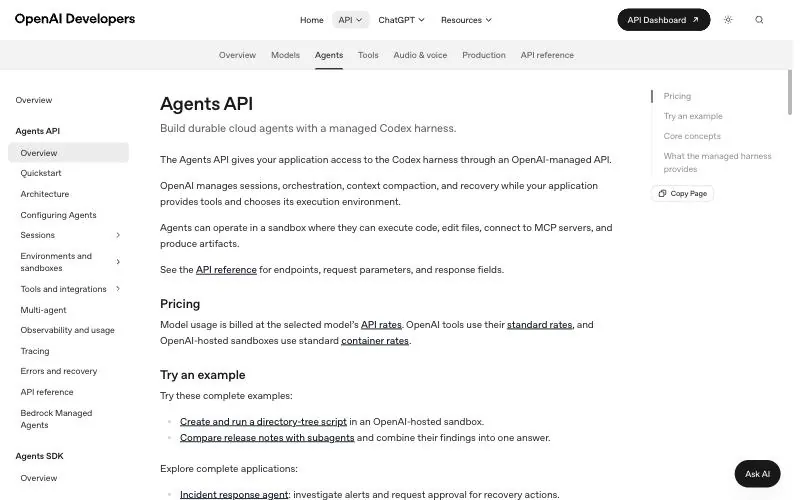
Status: public beta since September 10, 2026 (OpenAI).Pricing: "No extra Agents API fees"; tokens and tools at standard rates, for example gpt-6.1-sol at $2/$10 per million input/output tokens; hosted containers from $0.03 per 20-minute session for 1 GB (pricing).SDKs: examples in Python, TypeScript, Go, Java and Ruby; the Agents SDK (MIT) if you want to run the loop yourself.
The Agents API runs "cloud agents with the Codex harness, fully managed by OpenAI". The sandbox can be OpenAI-hosted, your own, or one from partners such as E2B, Modal, Daytona and Cloudflare. It includes context compaction, multi-agent orchestration, MCP, tool search and a hosted browser. It replaces much of what the Assistants API did; that API was shut down on August 26, 2026 (OpenAI).
Key strengths
- No platform fee on top of tokens and containers.
- Bring your own sandbox or use a partner's.
- The same harness as Codex, with SDK examples in five languages.
Best for: teams building general-purpose agents on OpenAI models who don't want to run the loop.
2. Claude Managed Agents: best for long-running agents on Claude
Status: beta since April 8, 2026; on the Claude API, Claude Platform on AWS and Google Cloud (Anthropic).Pricing: tokens plus $0.08 per session-hour, counted only while a session is running, not idle; for example Sonnet 5.5 at $2/$10 per million tokens (pricing).Tools: bash, file read and write, search, web fetch and web search, plus MCP and custom tools (docs).
Claude Managed Agents is Anthropic's hosted agent harness "best for long-running and asynchronous tasks". Sessions can run for hours and keep their output through disconnects, and since launch Anthropic has added memory, multi-agent orchestration, self-hosted sandboxes, scheduled deployments and session budgets. Anthropic names Notion, Rakuten, Asana and Sentry among its users. The Claude Agent SDK runs the same harness on your own servers.
Key strengths
- Simple pricing: tokens plus active runtime only.
- Self-hosted sandboxes keep tool execution on your infrastructure.
- Built for agents that run for hours.
Best for: teams on Claude that want hosted, long-running agents with little setup.
3. Sai API: best for tasks in desktop apps and sites with no API
Pricing: Explore $0 with daily credits; Pay as you go $50/month; Sai Unlimited $500/month; Enterprise custom (pricing).Computer: a real Windows, macOS or Linux computer; free accounts get one pooled Windows cloud computer.Use it from: your code, or Claude Code, Codex and Cursor through the @simular-ai/sai-mcp server.
The Sai API lets your code or your coding agent hand a task to a computer-use agent that works on a real Windows, macOS or Linux computer. You send a message, the agent works on the computer, and you read the result. Where the agent APIs above give a model a shell and files, this agent uses apps and websites the way a person does, by seeing the screen, clicking and typing, so it gets work done where there is no API: web apps behind a login, admin consoles, desktop software, forms with no import. When it needs permission, an approval request arrives that your code answers or a person opens, and for typed output your code can use, you add options to the message. Claude Code, Codex and Cursor call it through the @simular-ai/sai-mcp server, which one command installs.
On reliability, the Sai API has the highest partial score on the official OSWorld 2.1 leaderboard for computer-use agents, 79.38%, at $14.34 per task (see the results). Run a workflow once and it can be saved as a reusable skill: later runs replay it as code and ask the model only where the screen matters, so they are faster and cheaper, and the agent takes over when the UI changes.
Key strengths
- A full computer, not only a shell or a browser.
- No model keys to bring; the model and the computer are included in the plan.
- Sign-ins go to a person as an approval.
Best for: giving your agents a fleet of autonomous computers, for work in desktop apps and websites with no API.
4. Google Gemini API and Agent Runtime: best for Google Cloud teams and free-tier experiments
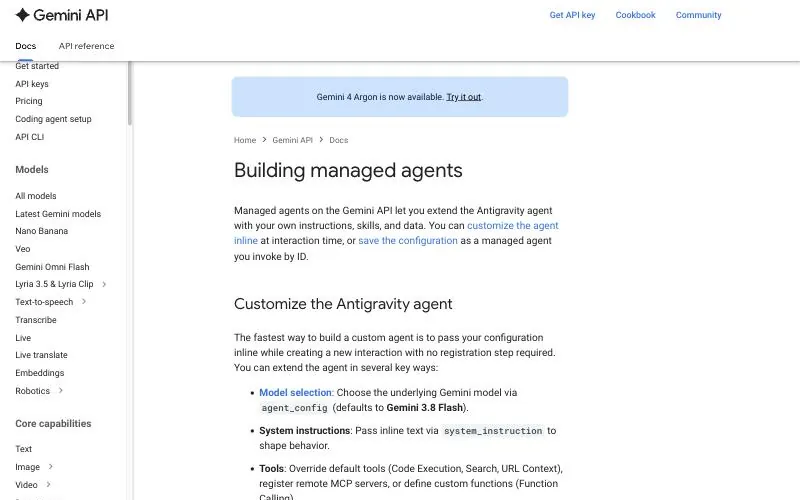
Gemini API managed agents: preview; a Google-hosted agent built on Gemini 3.8 Flash that runs Bash, Python and Node.js in a Linux sandbox; usable on free-tier projects (Google docs).Agent Runtime: $0.085 per vCPU-hour and $0.009 per GiB-hour after a monthly free tier of 50 vCPU-hours and 100 GiB-hours; idle time between turns is not billed (pricing).Rename: Vertex AI Agent Engine is now Agent Runtime on the Gemini Enterprise Agent Platform (Google).
Google offers two ways in. The Gemini API's managed agents let you send an interaction to a hosted agent with code execution, Google Search and remote MCP servers, including background runs, and Google also hosts Deep Research agents. On Google Cloud, Agent Runtime deploys your own agent, written with the open-source Agent Development Kit or another framework, to managed compute with sessions, memory and code execution.
Key strengths
- The most generous free tier on this list.
- Long-running agents, with idle time not billed.
- Hosted research agents as well as a general agent.
Best for: Google Cloud teams, and developers who want to try a hosted agent on a free tier.
5. Amazon Bedrock AgentCore: best for AWS teams using any model or framework
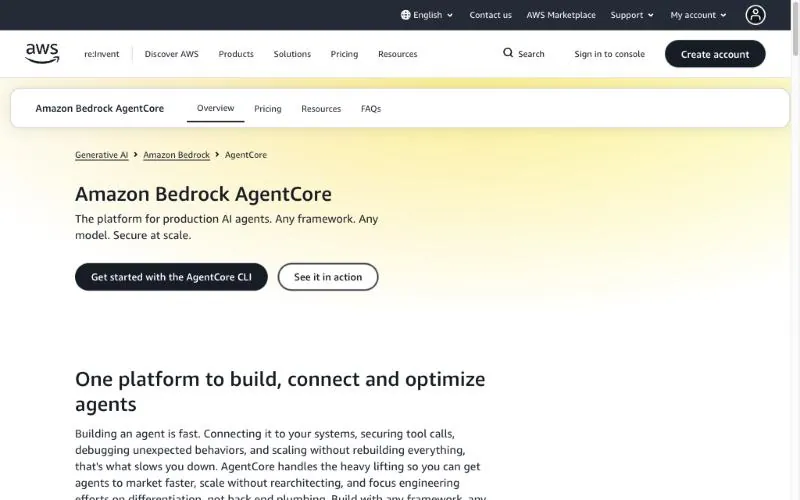
Status: GA since October 2025; Harness, a managed agent loop, GA since June 17, 2026 (AWS).Pricing: Runtime from $0.0895 per vCPU-hour and $0.00945 per GB-hour; Browser and Code Interpreter at the same rates; Gateway, Memory, Web Search and Policy metered separately; up to $200 in free-tier credits for new AWS customers (pricing).Models: any, in or outside Bedrock.
AgentCore is a set of services for running agents in your AWS account: Runtime for any framework (LangGraph, CrewAI, Google ADK, the OpenAI Agents SDK, Strands and others), plus Memory, Gateway, Identity, a cloud Browser, a Code Interpreter and Observability. Harness lets you "define and invoke AI agents with a single API call", each session in an isolated microVM with a filesystem and shell. Separately, Bedrock Managed Agents, built on a customized OpenAI Agents API, entered public preview on September 29, 2026 (AWS).
Key strengths
- Any model and any framework.
- AWS controls: VPC, PrivateLink, IAM and CloudTrail.
- A one-call managed loop, or bring your own agent code.
Best for: teams on AWS that want to host agents in their own account with any model.
6. Microsoft Foundry Agent Service: best for Azure and Microsoft 365 teams
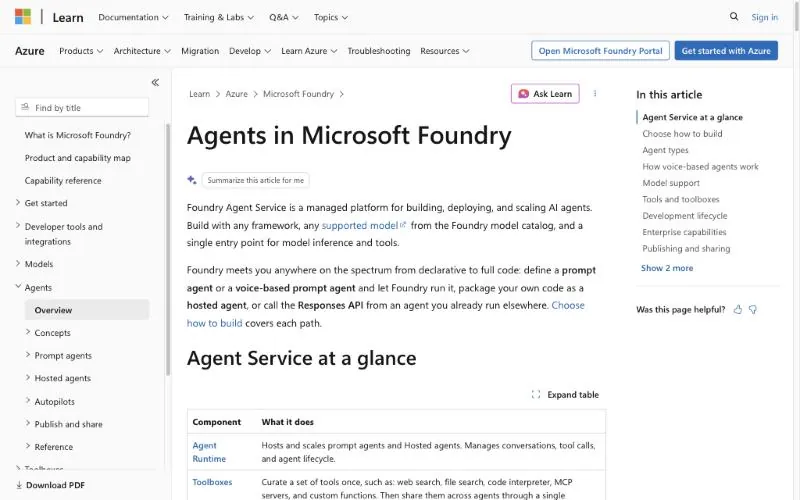
Agent types: prompt agents with no code, and hosted agents that run your container in Python or C# (docs).New: Microsoft Copilot harness, where "Microsoft runs the agent loop and sandbox", public preview October 28, 2026; free until December 1, then about $0.0994 per vCPU-hour (Microsoft).Pricing page: lists the meters, but not the rates, on the day we checked (Azure).
Foundry Agent Service, formerly Azure AI Foundry Agent Service, is "a managed platform for building, deploying, and scaling AI agents". Hosted agents can use any framework, including the OpenAI Agents SDK and the Claude Agent SDK, and each session gets its own VM-isolated sandbox. Agents get an Entra identity, MCP tools and a browser automation tool, and can be published to Teams and Microsoft 365.
Key strengths
- Any framework, with per-session VM isolation and scale to zero.
- Entra identity per agent and publishing to Teams.
- A generally available browser automation tool.
Best for: Azure customers that want agents tied to Entra and Microsoft 365.
7. Browser Use Cloud: best for web tasks and scraping
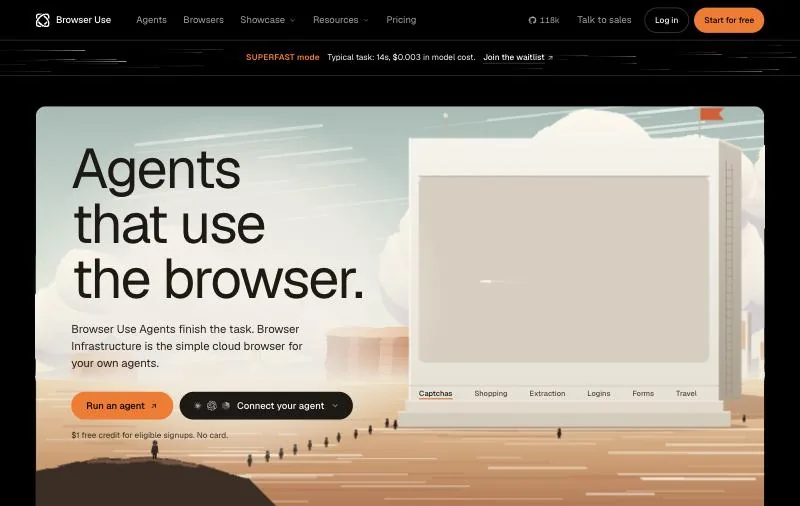
Pricing: pay as you go; browsers $0.02/hour, residential proxy $5/GB; agents at model cost plus 20%; $1 free credit (pricing).Typical task: V4 agent about $1.64 and about 5 minutes; V3 about $0.87 and 2 minutes, by Browser Use's own figures (docs).Open source: the browser-use library, MIT, about 119k GitHub stars.
Browser Use Cloud is a hosted browser agent: "Send a task, get the result as text or JSON" from a stealth cloud browser. It supports structured output, saved logged-in profiles, follow-up sessions, proxies by country, a live view and webhooks, through REST and Python and TypeScript SDKs.
Key strengths
- Cheap browser time and published cost per typical task.
- Structured output and saved profiles for logged-in sites.
- The largest open-source browser-agent community.
Best for: developers who need web tasks and data extraction as an API.
8. Manus API: best for general research and web tasks
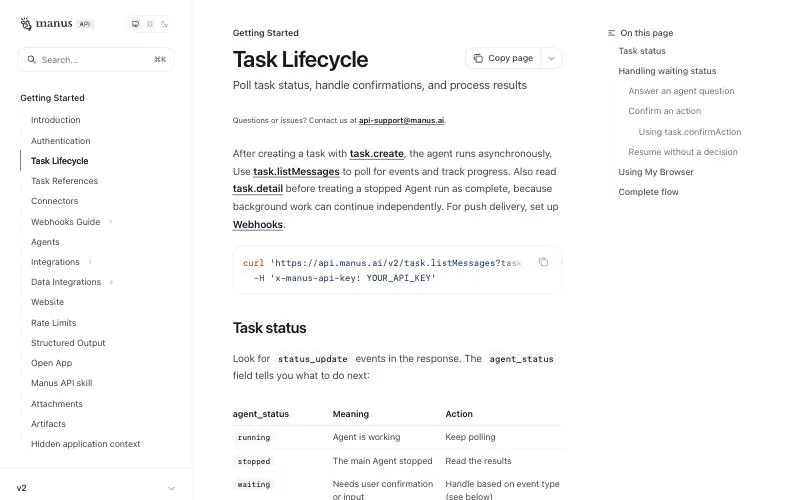
Pricing: credits; Free with 300 credits a day; Pro from $20/month for 4,000 credits; "each task consumes credits based on its complexity" (Manus).Status: API v2; v1 "is deprecated and will be removed" (Manus docs).Owner: acquired by Meta, reported in December 2025.
The Manus API runs Manus as a complete agent: create a task, read its messages, answer its questions or confirm actions, and fetch the result. It supports structured output, connectors such as Gmail and Notion, webhooks and file uploads, and it pauses for confirmation before high-credit actions.
Key strengths
- One call delegates a whole multi-step job.
- Human confirmation built into the task lifecycle.
- Connectors and webhooks included.
Best for: research and web tasks you want to hand off whole.
9. Devin API: best for coding tasks that end in a pull request
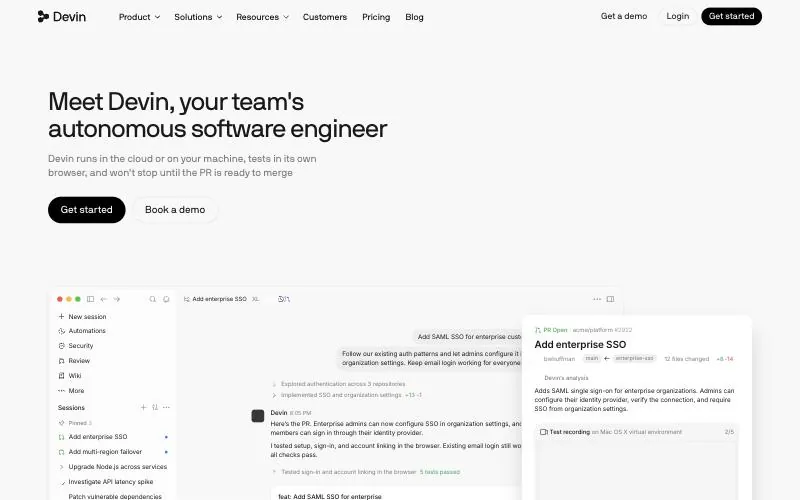
Pricing: Free; Pro $20/month; Max $200/month; Teams from $80/month; Enterprise billed in Agent Compute Units at a contract rate (pricing, billing docs).API: v3 is current; v1 and v2 are legacy.Spend control: a per-session max_acu_limit.
The Devin API from Cognition starts and manages cloud coding sessions: you send a prompt with repositories, playbooks, knowledge and secrets, and get back a session URL, its status, the compute it used and any pull requests it opened (API reference). Service users, role-based access and audit logs make it usable from CI and internal tools.
Key strengths
- A full coding agent with its own VM that returns pull requests.
- Enterprise access controls for API use.
- A hard compute cap per session.
Best for: engineering teams that want to hand coding tasks to an agent from their own tools.
What we left out
- OpenAI Assistants API was shut down on August 26, 2026 (OpenAI).
- Perplexity Agent API runs search and fetch tools over several steps across many models, but it has no sandbox or browser, so it is closer to a search-augmented model API than a task agent (Perplexity docs).
- Google's Jules API is still an alpha (
v1alpha) coding-agent API (Jules docs). - Agent frameworks and builders such as LangGraph, CrewAI and n8n run agents you host; see best AI agent builders.
How to choose
- You want a general agent on one vendor's model, hosted for you: OpenAI Agents API or Claude Managed Agents.
- You want to host your own agent code in your cloud account: AgentCore on AWS, Foundry on Azure, Agent Runtime on Google Cloud.
- The work happens in a browser: Browser Use Cloud.
- The work happens in desktop apps, or crosses websites and apps with no API: the Sai API.
- The work is code: Devin.
- You want to hand off open-ended research: Manus, or Google's Deep Research agents.
Status, prices and pricing units from each vendor's docs, pricing page and announcements, and SDK versions from PyPI and npm, on October 29, 2026. The Sai API is made by Simular, the publisher of this page.