





The best open-source computer use agent in 2026 depends on what you are building. Agent S from Simular is the strongest open framework: its newest release, Agent S4, lets an open 27B model build its own tools and lifts it from 5.6% to 21.3% on OSWorld 2.0, at $1.10 per task. UI-TARS Desktop is the most polished open desktop app, OpenCUA is the most fully open model family (weights, data and tools), and H Company's Holo4 is the newest open-weight model to watch. For infrastructure to run any of them safely, use Cua; for browser-only work, Browser Use.
This page is for developers and researchers choosing an open computer-use agent to run, study or build on. We list what is actually open in each project (code, weights, data), the license, and its published benchmark results with the benchmark, metric and step budget, because scores on different OSWorld versions cannot be compared. Every fact was checked on the project's repository, model card or paper on October 22, 2026; star counts are GitHub's figures that day. Agent S is made by Simular, the publisher of this page, so read its entry with that in mind; its results come from the paper and are quoted with their caveats.
What is a computer use agent?
A computer use agent (CUA) is an AI agent that operates a computer through its graphical interface: it looks at the screen, decides the next mouse or keyboard action, carries it out and checks the result, repeating until the task is done. The OSWorld paper describes the goal as autonomous agents that "accomplish complex computer tasks with minimal human interventions".
An open-source CUA usually has three parts, and projects open different ones: a model that reads screenshots and chooses actions (sometimes a separate grounding model that turns "the Save button" into coordinates), a harness that runs the loop and exposes actions and tools, and an environment, a real or virtual machine for the agent to work on. Agent S4's contribution is in the harness: it changes the interfaces the agent works through, not the model.
How to read CUA benchmark numbers
- OSWorld (2024) has 369 tasks in real Ubuntu, Windows and macOS apps; humans scored 72.36%. OSWorld-Verified is a cleaned-up version from July 2025.
- OSWorld 2.0 (June 2026) is much harder: 108 long-horizon tasks with a median human time of about 1.6 hours, scored by binary completion and a partial reward for progress. The official step limit is 500. The best result in its paper is Claude Opus 4.8 at 20.6% binary and 54.8% partial.
- A model's score depends on the harness, the step budget and whether runs are repeated (best-of-N). Compare numbers only on the same benchmark, metric and budget.
Comparison summary
| Project | Best for | What is open | License | Published result | OS |
|---|---|---|---|---|---|
| Agent S (S4, S3) | A full agent framework that improves its own tools | Code; S4 synthetic task set | Apache-2.0 | S4: 21.3% binary, OSWorld 2.0, 300 steps, $1.10/task. S3: 72.6% OSWorld (best-of-N) | Linux, Windows, macOS |
| UI-TARS / UI-TARS Desktop | A ready-made desktop agent app | App, CLI, 7B weights | Apache-2.0 | UI-TARS-1.5-7B: 27.5% OSWorld | Windows, macOS, browser |
| OpenCUA | Training and studying CUA models | 7B/32B/72B weights, data, tools | MIT | 72B: 45.0% OSWorld-Verified, 100 steps | Windows, macOS, Ubuntu |
| Holo4 | A new open-weight model to evaluate | Weights, trajectories | 27B: CC BY-NC 4.0; 35B-A3B: Apache-2.0 | 27B: 61.7% OSWorld 2.0, stated (metric not specified) | Via its own harness |
| Microsoft UFO | Windows automation research | Code | MIT | No headline score found | Windows (UFO3 adds Linux, Android) |
| Cua | Sandboxes and VMs for any agent | Infrastructure, SDKs, drivers | Mostly MIT; some FSL | Not an agent model | macOS, Windows, Linux |
| Browser Use | Web-only agents | Python library | MIT | No task-success benchmark stated | Browser |
| Self-Operating Computer | A simple, legacy starting point | Code | MIT | None | macOS, Windows, Linux |
The 8 best open-source computer use agents
1. Agent S (Simular): best open framework, now with self-evolving interfaces in S4
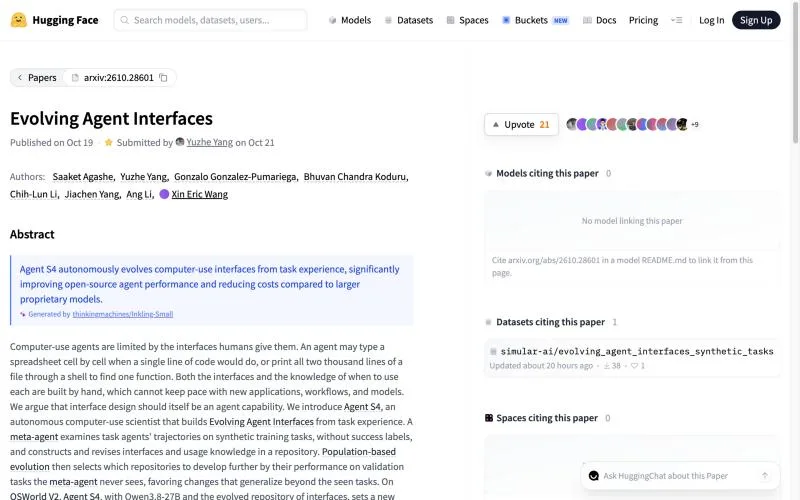
What is open: The framework code (simular-ai/Agent-S, Apache-2.0, 12.2k stars) and the S4 synthetic task set (Hugging Face).Runs on: Linux, Windows and macOS, with OpenAI, Anthropic, Gemini, OpenRouter or self-hosted vLLM models.Install: pip install gui-agents
Agent S is Simular's open agent framework, and each version has moved the open state of the art. Agent S2 (COLM 2025) introduced a generalist-specialist design. Agent S3 reached 72.6% on OSWorld with Behavior Best-of-N, the first result above the 72.36% human level; on its own, in the 100-step setting, it scores 66%. It also reports 56.6% on WindowsAgentArena and 71.6% on AndroidWorld.
Agent S4, released on October 20, 2026 in the paper "Evolving Agent Interfaces", asks a different question: instead of a bigger model, can the agent build better tools for itself? S4 is described as "an autonomous computer-use scientist". A meta-agent reviews the task agent's trajectories on synthetic practice tasks, without success labels, and builds or revises interfaces (new tools, extensions to existing ones, and guidance on when to use them). A population search keeps the variants that do best on held-out validation tasks, mixing mutation of one parent with crossover of two. The construction budget is two hours for OSWorld 2.0 and one hour for ScienceBoard, and the paper is explicit that "the meta-agent never observes any benchmark task while constructing interfaces." The model and harness stay fixed; only the interfaces change.
The results, on the full 108-task OSWorld 2.0 set with a 300-step budget:
| System | Binary | Partial | Cost per task |
|---|---|---|---|
| Qwen3.8-27B with fixed interfaces | 5.56% | 20.69% | $1.39 |
| Qwen3.8-27B + Agent S4 interfaces | 21.30% | 46.90% | $1.10 |
| Qwen3.8-27B + Agent S4 interfaces, with a scratch VM | 19.44% | 51.06% | $1.27 |
| GPT-5.5 (batched) | 13.00% | 49.50% | $25.50 |
| Claude Opus 4.8 (batched) | 20.60% | 54.80% | $72.40 |
That is about 3.8 times the open model's fixed-interface baseline, and a binary score just above Claude Opus 4.8's at about 1.5% of its cost per task. Two caveats, in fairness: Opus 4.8 is still ahead on partial score (54.8% against 46.9%), and the paper's 300-step budget is below OSWorld 2.0's official 500. On ScienceBoard, the same method lifts the open model from 41.4% to 58.6%. Simular's announcement adds that the run without a scratch VM built 4 new interfaces and 127 extensions, and the run with one built 12 and 253.
Why it matters for open source: S4's gains come from interfaces, not weights, so the same method can in principle sit on top of other open models. The paper and announcement point to the Agent S repository for the code, and the synthetic tasks are on Hugging Face.
pip install gui-agents
agent_s --provider openai --model gpt-5-2025-08-07 \
  --ground_provider huggingface --ground_url http://localhost:8080 \
  --ground_model ui-tars-1.5-7b --grounding_width 1920 --grounding_height 1080
Key strengths
- The strongest published open results: S3 above human level on OSWorld, S4 above Opus 4.8's binary score on OSWorld 2.0 with an open 27B model.
- Very low cost per task with open models: $1.10 on OSWorld 2.0.
- Model-agnostic, with a permissive Apache-2.0 license.
- Runs on Linux, Windows and macOS.
Limitations
- A framework, not an app: you bring the models, the grounding server and the machine.
--enable_local_envruns arbitrary Python and Bash on your machine; use a VM.- S4 trails Opus 4.8 on partial score, and building interfaces takes a construction run before you see the gains.
Best for: teams and researchers who want the strongest open agent framework, and anyone who wants an open model to approach closed-model results at a fraction of the cost.
2. UI-TARS and UI-TARS Desktop (ByteDance): best ready-made desktop agent app
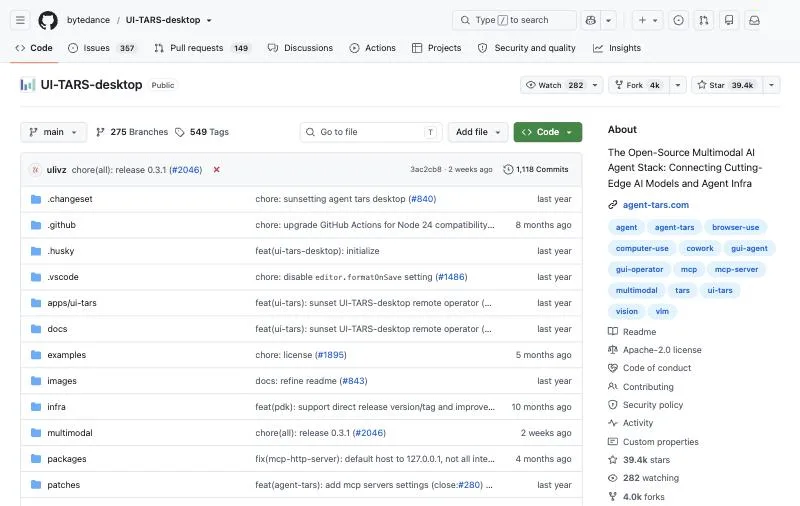
What is open: UI-TARS Desktop and Agent TARS (Apache-2.0, 39.4k stars) and the UI-TARS-1.5-7B weights (Apache-2.0).Runs on: Windows, macOS and the browser.Install: Desktop app from the releases page; npx @agent-tars/cli@latest for the CLI.
UI-TARS is ByteDance's family of GUI agent models, and UI-TARS Desktop is the most polished open app for running one on your own computer, with local and remote computer and browser operators. Agent TARS adds a CLI and web UI with MCP support. The open 7B model scores 27.5% on OSWorld; the full UI-TARS-1.5 scores 42.5% (100 steps) and UI-TARS-2 reports 47.5%, but those larger models are not openly downloadable.
Key strengths
- A native desktop app, not only a library.
- Open 7B weights under Apache-2.0, widely used as a grounding model.
- Local and remote operators.
Limitations
- The best models (full UI-TARS-1.5, UI-TARS-2) are not open.
- No news in the repository since November 2025.
- Needs a model endpoint, hosted or self-served.
Best for: people who want a desktop agent app they can install and try today.
3. OpenCUA (XLANG Lab): best fully open model family
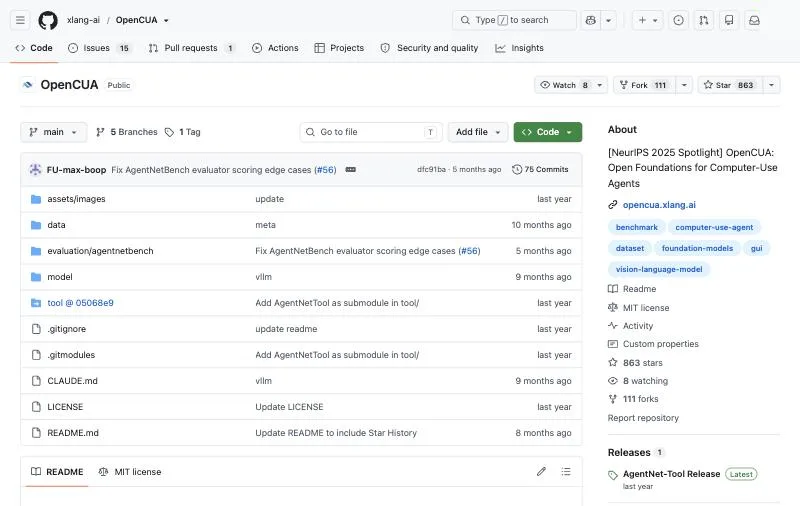
What is open: Code, models (7B, 32B, 72B), the AgentNet dataset and the AgentNetTool recorder, all MIT (repository).Runs on: The recorder runs on Windows, macOS and Ubuntu; models serve with vLLM 0.12+.Install: vllm serve xlangai/OpenCUA-7B --trust-remote-code
OpenCUA, from the team behind OSWorld, is the most complete open release on this list: weights, training data and the tool used to record it. On OSWorld-Verified (success rate, mean of three runs), OpenCUA-72B scores 45.0% at 100 steps, OpenCUA-32B 34.8% and OpenCUA-7B 26.6%. OpenCUA-72B was first on the OSWorld-Verified leaderboard among open models in October 2025.
Key strengths
- Weights, data and tools, all under MIT.
- Reproducible results, reported as the mean of three runs.
- Three sizes, from laptop-friendly to research scale.
Limitations
- A model, not an end-user app.
- The 72B model needs serious GPUs.
Best for: researchers training, fine-tuning or studying CUA models.
4. Holo4 (H Company): newest open-weight model to watch
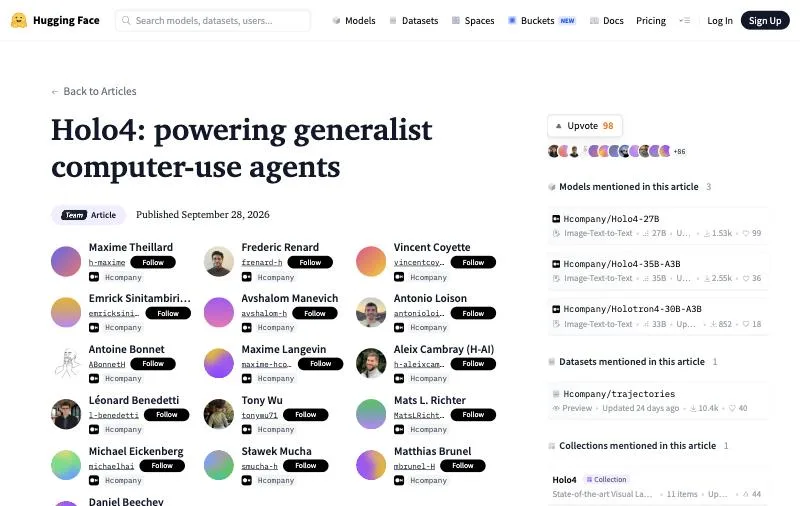
What is open: Weights for Holo4-27B (CC BY-NC 4.0, non-commercial) and Holo4-35B-A3B (Apache-2.0), plus trajectories.Released: September 28, 2026 (announcement).Run: vllm serve "Hcompany/Holo4-27B"
Holo4-27B is built on Qwen3.8-27B, the same base model Agent S4 uses, and H Company states 61.7% on OSWorld 2.0 at $1.22 per task, with 30.9% at $0.61 for the smaller Holo4-35B-A3B. Neither model card says whether that figure is binary or partial, or what step budget was used; the announcement's cost chart is labeled "average partial score", so it is most likely a partial score. On that reading it is above S4's 46.9% partial and Opus 4.8's 54.8%, but it cannot be compared with S4's 21.3% binary. The runs use H Company's own harness, which we could not find in public.
The two approaches are complementary: Holo4 trains a better model, while Agent S4 builds better interfaces around a fixed one. Nothing stops the second from being applied to the first.
Key strengths
- Strong stated OSWorld 2.0 results at low cost per task.
- An Apache-2.0 option (35B-A3B) for commercial use.
- Open trajectories.
Limitations
- The stronger 27B model is non-commercial (CC BY-NC 4.0).
- Metric and step budget for the headline score are not stated, and the harness is not public.
Best for: teams evaluating the newest open-weight CUA models, especially for non-commercial research.
5. Microsoft UFO: best for Windows automation research
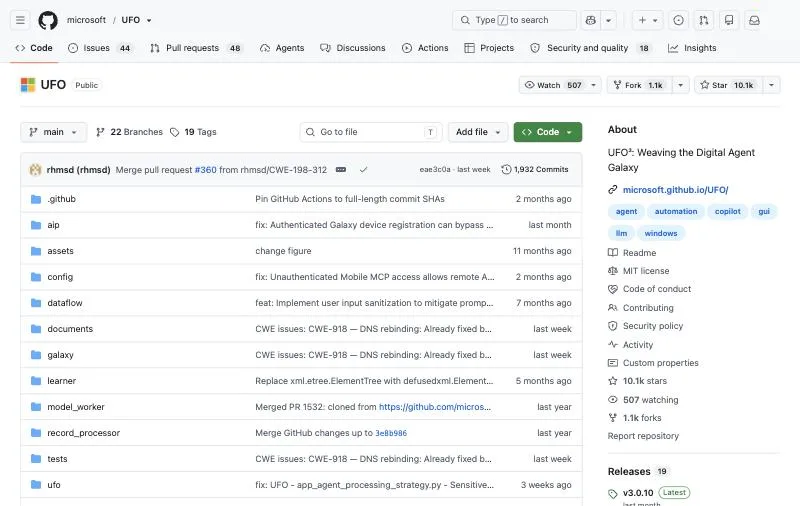
What is open: Code, MIT, 10.1k stars (repository).Runs on: UFO2 on Windows; UFO3 Galaxy orchestrates Windows, Linux and Android devices.Install: pip install -r requirements.txt, then python -m ufo --task <name>
UFO2 is a Windows "Desktop AgentOS" that combines UI Automation and native app APIs with vision, using a host agent and per-app agents, and can work in a picture-in-picture virtual desktop so it does not take over yours. UFO3 Galaxy, in active development since November 2025, plans tasks across several devices. It reports 51% fewer model calls from speculative multi-action execution; we did not find a headline benchmark score in its paper or README.
Key strengths
- Deep native Windows integration through UIA and app APIs.
- A separate virtual desktop for the agent.
- Multi-device orchestration in UFO3.
Limitations
- UFO2 is Windows-only and needs API model keys.
- No published headline score found.
Best for: Windows enterprise automation research.
6. Cua: best open infrastructure to run any agent safely
What is open: Sandboxes, VMs (Lume), the Cua Driver, SDKs in Python, TypeScript and Rust, and benchmark tools (about 30.5k stars).License: Mostly MIT; Cua Spaces and Driver Bench are FSL-1.1-MIT; one component is AGPL-3.0.Install: pip install cua
Cua is not an agent model but the layer underneath: macOS and Linux VMs on Apple silicon, Windows and Linux sandboxes, and a driver that agents use to see and act. It is the easiest way to give an open agent a disposable machine instead of your own.
Key strengths
- Sandboxes and VMs for any agent or model.
- SDKs in three languages, plus evaluation tools.
Limitations
- Some parts recently moved to the FSL license.
- No agent model of its own with headline scores.
Best for: builders who need safe, disposable machines for any CUA.
7. Browser Use: best for web-only agents
What is open: A Python library, MIT, about 118.4k stars (repository).Runs on: A browser only; local models through Ollama or hosted models.Install: uv add browser-use
Browser Use is the most popular open agent project on GitHub, but it only drives a browser. If every step is on the web, it is simpler and cheaper than a full desktop agent; it cannot reach native apps, file dialogs or remote desktops. Its best results lean on its paid cloud and its own model.
Best for: web automation where no desktop app is involved.
8. Self-Operating Computer: simplest legacy starting point
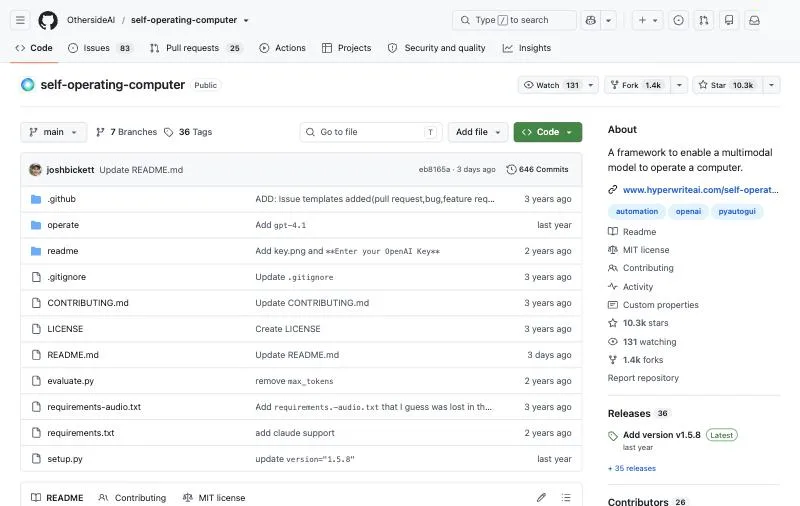
What is open: Code, MIT, 10.3k stars; latest release v1.5.8 (repository).Runs on: macOS, Windows and Linux (with an X server).Install: pip install self-operating-computer, then operate
One of the first open projects to let a multimodal model use a computer. It is still a readable starting point for how a CUA loop works, but its supported models list (GPT-4o, Claude 3, Gemini Pro Vision) shows its age, and it publishes no benchmark results.
Best for: learning how a basic computer-use loop is put together.
Also worth knowing: GTA1 from Salesforce AI Research is a family of grounding models (45.2% on OSWorld at 100 steps with an o3 planner), useful as the grounding half of an agent. Open Interpreter has pivoted to a coding agent and now hands computer use to other tools, so it is no longer a dedicated CUA.
Open source or a hosted computer-use agent?
Open agents give you control: your own models, your own machines and no per-task fee beyond compute. In exchange you run the model servers, the VMs, the harness and the evaluation yourself. A hosted agent trades that control for time. Sai, Simular's hosted agent built on the Agent S research, has the highest partial score on the official OSWorld 2.1 leaderboard, 79.38%, and is the only entry that publishes its cost, $14.34 per task (see the results). Many teams prototype with an open framework and move production runs to whichever option is cheaper to operate.
How to choose an open-source computer use agent
- You want the strongest open agent framework, or open-model results close to closed models: Agent S, with S4 interfaces.
- You want an app to install and try today: UI-TARS Desktop.
- You want to train or study models, with data: OpenCUA.
- You want the newest open weights for research: Holo4.
- You automate Windows specifically: Microsoft UFO.
- You need safe machines for any of the above: Cua.
- Everything is in a browser: Browser Use.
Licenses, versions, star counts and benchmark results checked on each project's repository, model card or paper on October 22, 2026. Agent S and Sai are made by Simular, the publisher of this page.