


The best BrowserStack alternatives depend on what you test. Sauce Labs is the closest like-for-like cloud, with emulators, simulators and real devices. TestMu AI (formerly LambdaTest) has the lowest entry prices and a free tier. TestingBot is the cheapest with month-to-month billing. AWS Device Farm and Azure Playwright Workspaces bill by the minute. Perfecto, Kobiton and BitBar suit enterprise and mobile-first teams. And Sai is a different kind of alternative: an agent that runs your end-to-end checks from a plain-English description, so there is no test script to maintain.
This page is for QA engineers and developers comparing testing clouds on price, coverage and parallel limits. Prices below are list prices in US dollars from each vendor's own pricing page on October 23, 2026; "annual" means billed yearly. Nothing here is sponsored. Sai is our product, so its entry says where it is the wrong pick.
What BrowserStack offers, and why teams look elsewhere
BrowserStack is a cloud testing platform: real browsers and real mobile devices you use by hand (Live, App Live) or drive with Selenium, Playwright, Cypress or Appium tests (Automate, App Automate), plus visual testing (Percy) and test management.
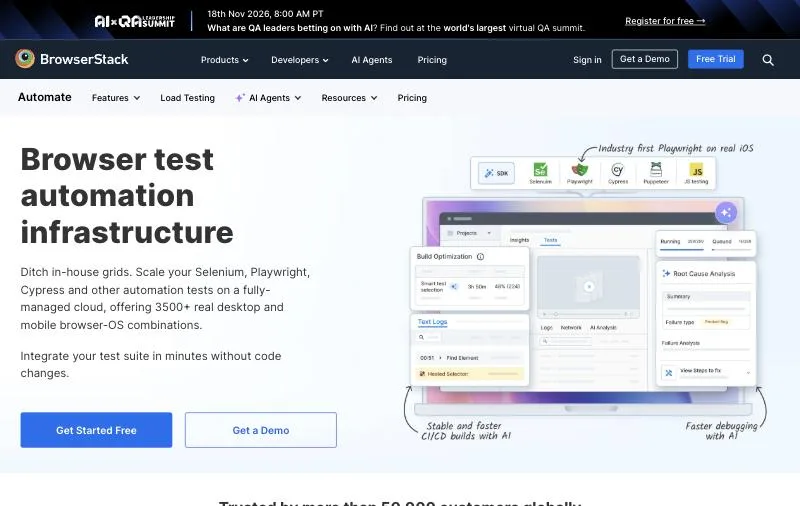
Its Automate page offers "3500+ real desktop and mobile browser-OS combinations" (BrowserStack). On the pricing page, Live starts at $29 a month annual for desktop browsers, and Automate is priced per parallel test: $99 a month annual for Desktop, $175 for Desktop & Mobile and $225 for Desktop & Mobile Pro. In June 2025 it launched a suite of AI agents for test generation, self-healing and failure analysis (press release).
The usual reasons teams compare alternatives:
- Cost per parallel. Each extra parallel test is another $99 to $225 a month on annual billing, and suites grow faster than budgets.
- Queue limits. Accounts with 1 to 5 parallels can queue only 5 extra tests, and queued tests are dropped after 15 minutes (BrowserStack docs).
- Short trials. The free trial includes 60 minutes of Automate and 30 minutes of Live (BrowserStack).
- Script maintenance. A device cloud runs your scripts; it does not write or repair them. That cost sits with your team.
How we evaluated
- Coverage: desktop browsers and operating systems, real devices, emulators and simulators.
- Frameworks: Selenium, Playwright, Cypress, Appium, Espresso and XCUITest.
- Price and billing: published price of the entry automation plan, monthly or annual, per parallel or per minute.
- Trial or free tier you can start without talking to sales.
- AI features, and which plans include them.
Comparison summary
| Platform | Best for | Real devices | Frameworks | Entry automation price | Free option |
|---|---|---|---|---|---|
| Sauce Labs | A like-for-like enterprise cloud | Yes | Selenium, Playwright, Cypress, Appium, Espresso, XCUITest and more | $149/month annual (virtual devices) | Trial |
| TestMu AI (LambdaTest) | Lowest entry price | Yes | Selenium, Playwright, Cypress, Puppeteer, Appium and more | $79/month annual ($29 Linux-only) | Free tier: 100 minutes, 2 parallels |
| Sai | End-to-end checks without scripts | No; Windows and Linux cloud computers | Plain English, over HTTP or MCP | Pay as you go $50/month | Free plan, daily credits |
| TestingBot | Cheap monthly billing | Yes | Selenium, Playwright, Puppeteer, Cypress, Appium, Maestro | $50/month annual, $70 monthly | 14-day trial |
| Perfecto | Regulated enterprises | Yes | Selenium, Appium, Playwright, Espresso, XCUITest | Quote; 12-month minimum | Demo |
| Kobiton | Mobile apps on real devices | Yes (mobile only) | Appium, XCUITest, Espresso | From $83/month, 500 minutes | Trial |
| BitBar | SmartBear shops, dedicated devices | Yes | Selenium, Appium, XCUITest, Flutter | Not published | 14-day trial |
| AWS Device Farm | Pay per minute on AWS | Yes | Appium, Espresso, XCTest, Selenium | $0.17 per device-minute | Free device minutes to start |
| Azure Playwright Workspaces | Playwright suites at scale | No | Playwright only | Per browser-minute | 30 days, 100 minutes |
The 9 best BrowserStack alternatives
1. Sauce Labs: best like-for-like enterprise alternative
Coverage: Desktop browsers, emulators and simulators, and real mobile devices.Pricing: Live Testing $39/month annual or $49 monthly; Virtual Device Cloud $149 or $199; Real Device Cloud $199 or $249 (pricing).AI: Sauce AI agents for test authoring and insights are listed on Enterprise.
Sauce Labs covers the same ground as BrowserStack: live and automated testing on browsers and devices, with Selenium, Playwright, Cypress, TestCafe, WebdriverIO, Appium, Espresso and XCUITest. Its self-serve plans publish both monthly and annual prices and include visual snapshots. In July 2026 it launched AURA, which it describes as a closed-loop agentic platform for test automation and release assurance (Sauce Labs).
Key strengths
- Broad framework support, including Cypress and TestCafe.
- Emulators, simulators and real devices in one place.
- Published monthly prices.
Limitations
- AI agents are Enterprise-only.
- Self-serve plans stop at 5 concurrent sessions.
Best for: enterprise teams that want a mature, framework-agnostic BrowserStack replacement.
2. TestMu AI (formerly LambdaTest): best low-cost alternative with a free tier
Name: LambdaTest renamed itself TestMu AI in January 2026; lambdatest.com/pricing now redirects to testmuai.com.Pricing (annual): Virtual Live $15/month; Web Automation on Desktop $79/month, or $29 for Linux-only (pricing).Free tier: 100 automation minutes and 2 parallels, plus limited live sessions.
TestMu AI offers browsers, real devices, emulators and simulators, with HyperExecute for fast orchestration and SmartUI for visual tests. It has the widest list of AI products here: the KaneAI test-authoring agent (from $17 a month annual), self-healing, root-cause analysis, an MCP server, and testing for AI agents themselves, including chat and voice. It reports more than 3 million users.
Key strengths
- The lowest published entry prices among the major clouds.
- A free tier with real automation minutes.
- Many AI agent products.
Limitations
- Pricing is split across many separate products.
- The $29 automation plan is Linux browsers only.
- The rename means older guides still say LambdaTest.
Best for: cost-conscious teams that want BrowserStack-like breadth and AI test authoring.
3. Sai: best for end-to-end checks you don't want to script
Runs on: Windows and Linux cloud computers, with a real browser and desktop.How it works: You describe the check, such as "sign up with a new email, confirm the link and check the dashboard loads"; Sai does it from the screen and returns pass or fail with screenshots.Pricing: Free plan with daily credits; Pay as you go $50/month (pricing).
BrowserStack and every other cloud here run test scripts your team writes and maintains. Sai is not a device grid. It is a computer-use agent that carries out a test the way a tester would, so the flow can cross a browser, an email inbox, a downloaded file and a desktop app in one run, and a changed button label does not break it. Start runs from CI with one HTTP call, or from Claude Code, Codex or Cursor over MCP; sign-ins and other sensitive steps come to you as an approval.
On reliability, Sai has the highest partial score on the official OSWorld 2.1 leaderboard, 79.38%, at $14.34 per task (see the results). Checks you repeat can be saved and replayed as code, which for repetitive tasks can cut cost by up to 90%.
Key strengths
- No test scripts or selectors to maintain.
- Flows that leave the browser: email, files, desktop apps and admin consoles.
- Screenshots and evidence for every check.
Limitations
- No real phones or tablets, no Safari or macOS, and no browser-version matrix: use a device cloud for compatibility testing.
- Not a Selenium or Playwright grid; it does not run your existing test code.
- Slower and costlier per run than a scripted test; keep fast regression suites in code.
Best for: release checks and exploratory end-to-end flows that are expensive to script and keep breaking.
4. TestingBot: best for small teams on monthly billing
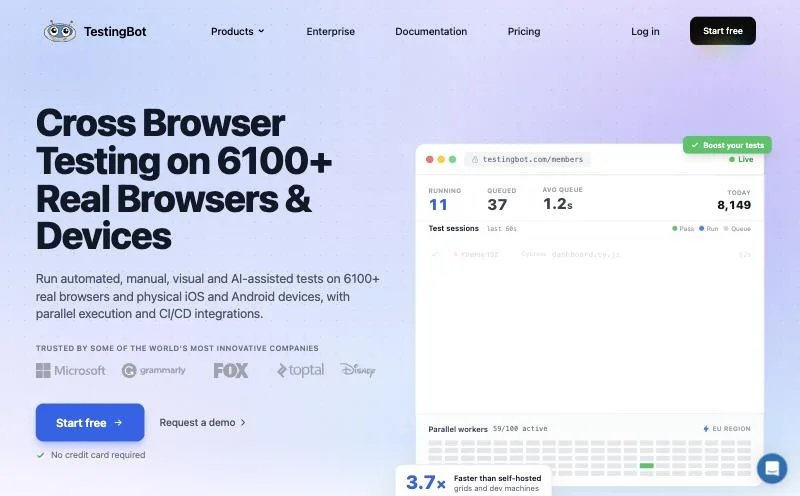
Coverage: "6100+" real browsers and devices: Windows, macOS and Linux browsers, real iOS and Android devices.Pricing: Automated $50/month annual or $70 monthly; Automated Pro $90 or $120; pay-as-you-go $60 for 1,000 minutes (pricing). Prices exclude VAT.Trial: 14 days, no credit card.
TestingBot is a smaller, developer-focused cloud with Selenium, Appium, Playwright, Puppeteer, Cypress, XCUITest, Espresso and Maestro support. It is the cheapest automated plan here with month-to-month billing, and its pay-as-you-go minutes never expire. It also offers an AI test agent and an MCP server for Claude Code and Cursor.
Key strengths
- Low monthly prices and pay-as-you-go minutes.
- Playwright, Puppeteer and Maestro support.
Limitations
- A smaller device catalog than BrowserStack.
- Enterprise plans start at 10 or more parallels through sales.
Best for: small teams and freelancers who want cheap automation without an annual contract.
5. Perfecto: best for regulated enterprises
Maker: Perforce.Coverage: Real iOS 17 to 27 and Android 10 to 17 devices, simulators and emulators, and Windows and macOS browsers (supported platforms).Pricing: Quote only, licensed per parallel execution, with a 12-month minimum.
Perfecto is built for enterprises that need SLAs, private device clouds and current OS versions on day one. It supports Selenium, Appium, Playwright (on Windows Chrome and Edge), Espresso and XCUITest, and offers AI test creation in plain English, AI reporting and self-adapting tests.
Key strengths
- Private clouds and an uptime SLA.
- Real macOS machines and current device OS versions.
Limitations
- No self-serve pricing, and a 12-month minimum.
- Cypress is not on its supported list.
Best for: banks, insurers and other regulated teams that need private devices and SLAs.
6. Kobiton: best for mobile apps on real devices
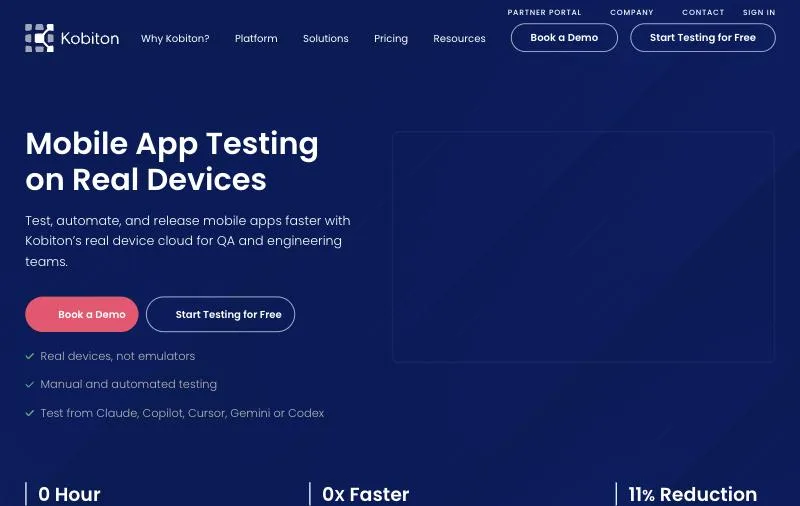
Coverage: Real mobile devices only ("Real devices, not emulators"), in the cloud or on premises.Pricing: Startup from $83/month for 500 minutes; Accelerate from $399 for 3,000 minutes; Scale from $9,000 a year (pricing).Frameworks: Appium, XCUITest, Espresso.
Kobiton is mobile-first: manual and automated testing on real phones and tablets, with Appium self-healing and script generation, no-code validations and an Appium MCP server, so tests can be started from Claude, Copilot, Cursor, Gemini or Codex. An on-premises option suits teams that cannot send builds to a public cloud.
Key strengths
- Strong Appium tooling.
- On-premises devices.
Limitations
- No desktop browser testing.
- Minute caps on entry plans, and self-healing is Enterprise-only.
Best for: mobile app teams that rely on Appium or need devices on premises.
7. BitBar: best for SmartBear shops that want dedicated devices
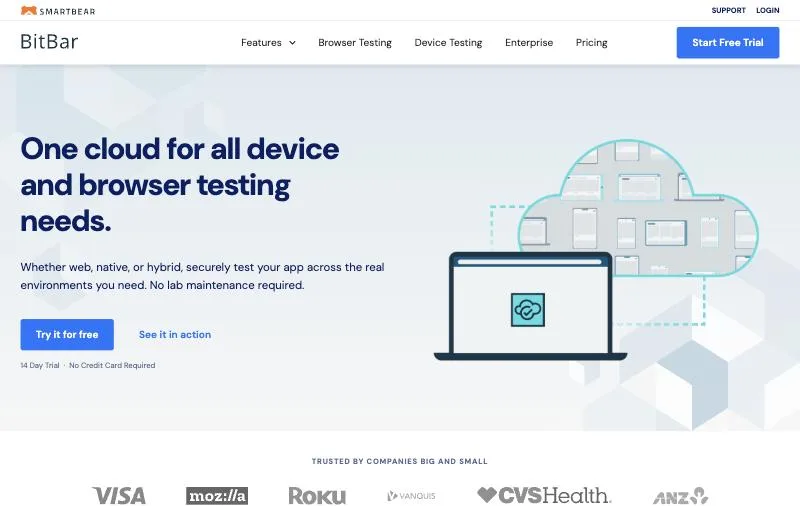
Maker: SmartBear.Coverage: Real browsers and real iOS and Android devices, in a public or private cloud.Trial: 14 days, no credit card; prices are not published in the pricing page text.
BitBar offers browser and device testing with Selenium, Appium, XCUITest and Flutter, and dedicated devices that are not shared with other customers. It fits teams already on SmartBear tools such as TestComplete. Note the trial is limited: a subset of devices, automated runs once an hour and live sessions capped at 4 minutes (SmartBear docs).
Key strengths
- Dedicated devices and a private cloud option.
- Fits the SmartBear ecosystem.
Limitations
- Prices are hard to find, and the trial is restrictive.
- No AI features on the product page.
Best for: SmartBear customers who want dedicated or private devices.
8. AWS Device Farm: best pay-per-minute option for AWS teams
Coverage: Real Android and iOS devices; desktop Chrome, Firefox and Edge on Windows only (AWS docs).Pricing: $0.17 per device-minute, or unmetered from $250 per device slot a month; desktop browsers $0.005 per instance-minute (pricing).Region: "only available in the us-west-2 (Oregon) region" (AWS docs).
AWS Device Farm is the only true metered option here for real devices: no plan, no annual contract, and a free allowance of device minutes to start. It supports Appium, Espresso and XCTest on devices and Selenium WebDriver on desktop browsers, and plugs into IAM and VPC.
Key strengths
- Pay only for the minutes you use.
- Very cheap desktop Selenium.
- AWS IAM and VPC integration.
Limitations
- No macOS or Safari for desktop testing.
- One region, and not every Selenium feature is supported.
Best for: AWS-native teams that want metered device testing without a contract.
9. Azure Playwright Workspaces: best for Playwright suites at scale
Maker: Microsoft, part of Azure App Testing. It replaced Microsoft Playwright Testing, which was retired on March 8, 2026.Coverage: Cloud browsers on Linux and Windows; Playwright 1.50 or later.Pricing: Per browser-minute (pricing); free trial of 30 days and 100 browser minutes (Microsoft).
Playwright Workspaces runs your existing Playwright tests on cloud browsers with up to 100 parallel workers per workspace, without managing browser infrastructure. It authenticates with Entra ID, keeps data in region, and now also serves browser automation for AI agents, including a remote MCP server.
Key strengths
- Consumption pricing and high parallelism.
- Entra ID and data residency.
Limitations
- Playwright only.
- No real devices, and no macOS or Safari listed.
Best for: Playwright-first teams already on Azure.
What we left out
- Firebase Test Lab is being shut down: it "will be fully shut down on September 30, 2027" (Firebase).
- Selenoid, a popular self-hosted grid, was archived in December 2024 and is marked unmaintained (GitHub).
- Self-hosted Selenium Grid is free, but you run and patch the browsers and machines yourself, and it has no real devices.
How to choose
- You want BrowserStack's breadth from another vendor: Sauce Labs.
- Price matters most: TestMu AI, or TestingBot for month-to-month billing.
- You pay by usage and live on AWS: AWS Device Farm. On Azure with Playwright: Playwright Workspaces.
- You need SLAs and private devices: Perfecto, or BitBar for SmartBear shops.
- You test mobile apps only: Kobiton.
- Your problem is writing and fixing scripts, not running them: Sai.
Prices are list prices in USD from each vendor's pricing page on October 23, 2026; coverage, frameworks and trials from the vendors' product pages and docs the same day. Sai is made by Simular, the publisher of this page.